Web
← All workSmall Business Resource Hub
A WordPress site that helps entrepreneurs discover classes and support, built within a nonprofit budget.
Summary
Community Business Partnership is a Springfield, Virginia nonprofit that supports small businesses across Northern Virginia and the DMV. It offers free training workshops, technical assistance in accounting, marketing, and government contracting, incubator space for startups, and access to capital through microloans. As its services grew, its website hadn't kept up. Entrepreneurs couldn't easily browse upcoming workshops or understand what classes covered, and many didn't realize the organization offered much more than training. The organization already relied on a separate booking system for registration and payments. That system worked well for logistics but was never meant to market classes, so the jump from website to booking system created friction.
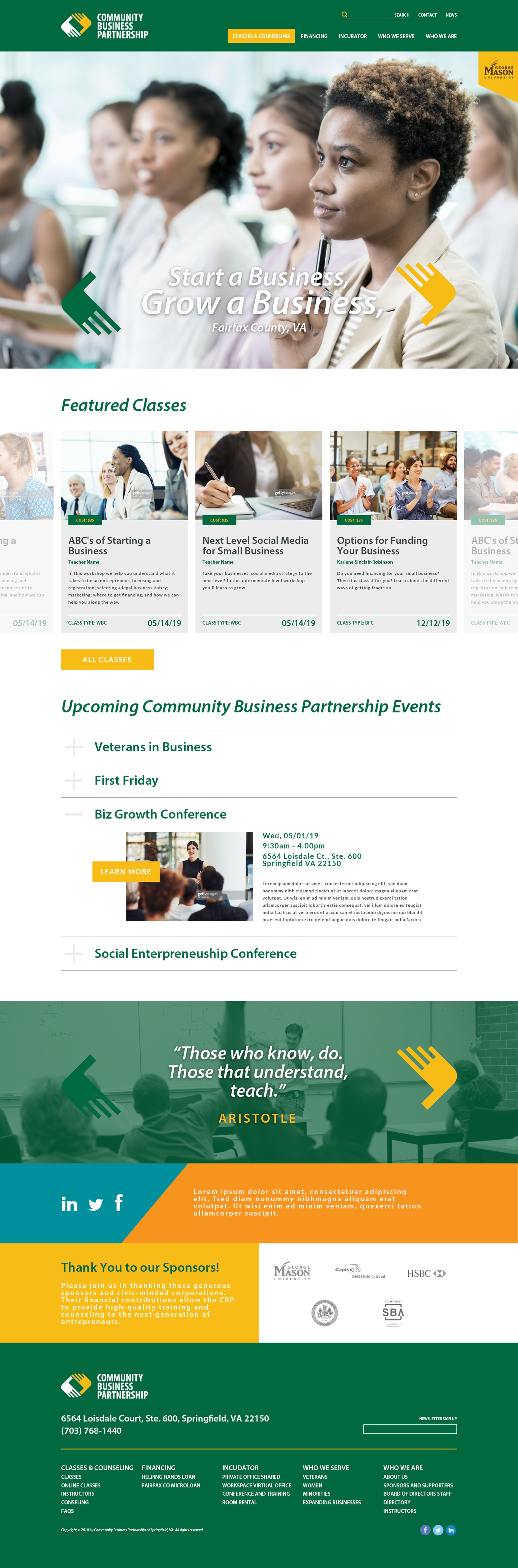
Over four months, I redesigned and rebuilt the site in WordPress to make classes visible, appealing, and easy to act on. A class showcase highlighted upcoming offerings with clear descriptions, schedules, formats, and prerequisites, plus prominent calls to action leading to registration. An API connection pulled current class data from the existing booking system, so the site stayed up to date without the organization replacing a tool it had already paid for. Beyond classes, I organized the full range of services around the stages of starting and growing a business, from incubator space to workshops, technical assistance, and loans. The site also showed how the organization fit alongside partners like the SBA and Fairfax County's economic development programs.
Budget shaped every decision. Building booking directly into WordPress would have been the smoothest experience, but it was out of reach. The API approach meant staff would need to add promotional copy and images in WordPress on top of the logistics in the booking system. I was upfront about that trade-off so the organization could choose with full information, then streamlined content entry to keep the extra work small. Building on a theme, choosing plugins carefully, and creating templates staff could use on their own kept the site affordable to build and maintain without ongoing design support.
Outcomes
- Classes that sell themselves. Entrepreneurs could browse, understand, and register for workshops in one clear flow instead of hunting through a utilitarian booking tool.
- The full range of support, visible. Services organized around business stages helped visitors see how the organization could help them now and later.
- Existing investment preserved. The API integration improved the experience without replacing a booking system the organization already relied on.
- A site staff can run. Templates and a streamlined editing experience let staff add content on their own, keeping long-term costs low.
Artifacts
- Site Map & Information Architecture
- Class Showcase Design
- High-Fidelity Mockups
- WordPress Templates
- Responsive Website
Methods
- Stakeholder Interviews
- Information Architecture
- Visual Design
- WordPress Development
- API Integration